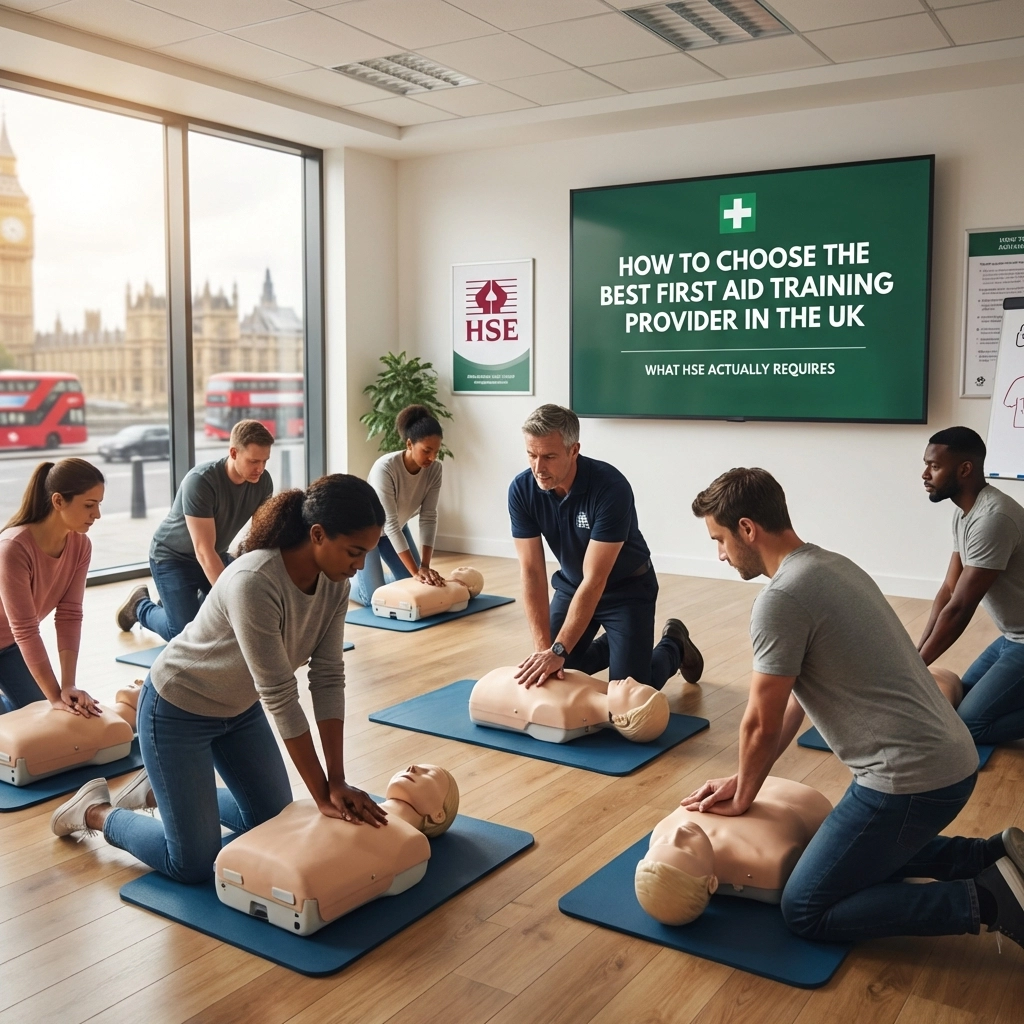
If you're responsible for health and safety at your workplace, you've probably found yourself asking: "How do I actually choose a first aid training provider?" And more importantly: "What does the HSE actually require?"
It's a fair question. There's a lot of confusing information out there, and making the wrong choice could leave your business non-compliant, your staff undertrained, or both.
The good news? Once you understand what the Health and Safety Executive (HSE) genuinely requires (and what it doesn't), choosing the right provider becomes much simpler.
Let's cut through the noise.
Here's something that surprises a lot of employers: the HSE does not approve first aid training providers.
That's right. Since 1st October 2013, the HSE stopped offering approval for general workplace first aid courses. So if a provider is claiming to be "HSE approved" or using that phrase as a selling point, that's a red flag.
Instead, the responsibility falls on you: the employer: to carry out due diligence and select a competent training provider that meets HSE quality criteria.
This might sound like extra work, but it actually gives you more flexibility. You're not limited to a short list of approved companies. You just need to know what to look for.

While the HSE doesn't hand out stamps of approval, it does set clear quality standards that any reputable training provider should meet. When evaluating a provider, the HSE says you should consider:
The HSE regulations say training should be taught in line with:
The First Aid Quality Partnership (FAQP) also publishes recommended quality assurance standards for training providers to follow.
Now for the practical bit. Here's a step-by-step guide to finding a provider you can trust.
The HSE acknowledges certain organisations as standard-setters in first aid training. These include Voluntary Aid Societies (VAS).
If a provider is one of these, that's a strong indicator of quality. However, it's not the only route to legitimacy.
Training providers can demonstrate competence through several routes:
Don't be afraid to ask a provider directly: "Who accredits your courses, and how do you ensure quality?"

A course is only as good as the person delivering it. Ask potential providers:
A competent trainer should have a recognised teaching qualification, up-to-date first aid credentials, and ideally, hands-on experience in emergency response or healthcare.
Make sure the provider can clearly explain how their training meets HSE syllabus requirements. For a First Aid at Work (FAW) course, this should include:
For an Emergency First Aid at Work (EFAW) course, the syllabus is shorter but should still cover the essentials like CPR, choking, and bleeding control.
If a provider can't tell you exactly what's covered: or their syllabus seems vague: move on.
Proper assessment is crucial. Learners should be evaluated on both their knowledge and practical skills. This might include:
Avoid providers who seem to hand out certificates without genuine evaluation. A certificate should mean something.

First aid certificates in the UK are typically valid for 3 years. After that, your staff will need to retrain to stay compliant.
However, here's something many employers overlook: the HSE strongly recommends annual refresher training to keep skills sharp. First aid isn't like riding a bike: if you don't practice, you forget.
When choosing a provider, ask whether they offer refresher courses or top-up training. This can be a cost-effective way to maintain competence without putting everyone through a full course every year.
Not all training providers are created equal. Here are some warning signs that should make you think twice:
Choosing the right first aid training provider isn't just about ticking a compliance box. It's about making sure your people have the skills and confidence to act in an emergency.
A workplace accident can happen to anyone, at any time. When it does, the difference between a trained first aider and an untrained one could be the difference between life and death.
Beyond the human impact, there are legal considerations too. Under the Health and Safety (First-Aid) Regulations 1981, employers must provide adequate first aid equipment, facilities, and personnel. If your training doesn't meet the required standards, you could face enforcement action: or worse, find yourself liable if something goes wrong.
Before you book, run through this quick checklist:
If you can tick all these boxes, you're likely looking at a competent provider.
Finding the best first aid training provider in the UK doesn't have to be complicated. The key is understanding that the HSE doesn't approve providers: but it does set clear standards. Your job is to do your homework and choose a provider that genuinely meets those standards.
Look for proper accreditation, qualified trainers, transparent course content, and robust assessment. Avoid anyone making dubious claims or cutting corners.
Get it right, and you'll have a team of confident, capable first aiders ready to respond when it matters most. And that's something every workplace needs.
